
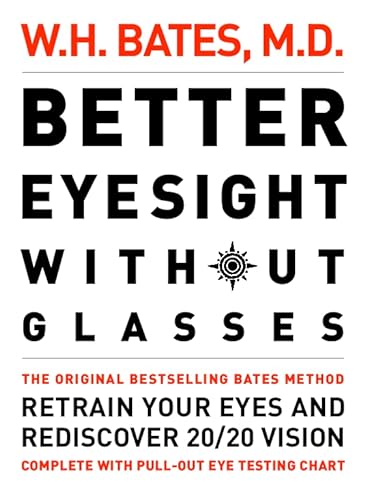
The core philosophy of William Horatio Bates’s 1920 work, "Better Eyesight Without Glasses," rests on the radical premise that most visual defects are not permanent physical deformities but are instead functional disorders caused by mental and physical strain (Bates, 1920). Bates, an experienced ophthalmologist, challenged the prevailing medical consensus of his time by asserting that the eye does not focus by changing the shape of its internal lens via the ciliary muscle. Instead, he proposed that the entire eyeball changes shape through the action of the six extrinsic muscles surrounding it (Jabir S et al., 2024). According to his theory, myopia or nearsightedness occurs when the oblique muscles pull the eye into an elongated shape, while hyperopia or farsightedness occurs when the recti muscles pull it into a flattened state (Sicotte, n.d.). By identifying strain as the root cause of these muscular imbalances, Bates argued that vision could be restored to normal by teaching the mind and eyes to relax.
Bates famously characterized glasses as "eye crutches" that do nothing to cure the underlying condition of the eye but rather perpetuate the very strain they are meant to alleviate (Albini & Riva, 2020). He believed that when a person puts on corrective lenses, the eyes stop making the effort to see naturally and instead adapt to the artificial correction, which often leads to a progressive worsening of vision over time. To counter this, Bates developed a series of techniques designed to re-educate the visual system. One of the most fundamental of these is central fixation. Bates observed that the human eye is designed to see only one small point clearly at a time—the center of the visual field. When an individual attempts to see a large area with equal clarity, they create a state of eccentric fixation, which results in significant strain. The goal of his method is to return the eye to its natural state of central fixation, where the mind acknowledges that it can only see one thing best at a time (Bates, 1920).
Another cornerstone of the Bates Method is the practice of palming. This involves closing the eyes and covering them with the palms of the hands in a way that excludes all light without putting pressure on the eyeballs. By visualizing perfect blackness during palming, the individual encourages the optic nerve and the mind to achieve a state of deep relaxation. Bates argued that if the mind can be perfectly relaxed, the eyes will follow, and refractive errors will momentarily or even permanently vanish. This emphasis on the mental component of vision is what sets his work apart from traditional ophthalmology; he maintained that "perfect sight" is a product of a relaxed mind, and any form of mental effort—whether anxiety, concentration, or the desire to see—only serves to blur the image (Sicotte, n.d.).
Movement and shifting are also vital components of his system. Bates noted that healthy eyes are in constant motion, shifting several times per second. People with poor vision, however, often develop a habit of staring, which locks the eyes into a rigid, strained position. To break this habit, Bates recommended "the swing" or "the sway," where the individual moves their body or head from side to side while letting the visual field appear to move in the opposite direction. This practice helps to integrate the eyes with the body’s natural rhythm and discourages the static tension that leads to blurred vision. Similarly, "sunning" or exposing the closed eyes to direct sunlight was suggested as a way to stimulate the retina and relax the ocular muscles, though this remains one of his most controversial recommendations in modern medical contexts (Albini & Riva, 2020).
Memory and imagination play a surprisingly large role in the Bates Method. Bates claimed that if a person can remember or imagine a small, black object—like a period on a page—with perfect clarity while their eyes are closed, they will find their vision improved when they open them. This is because the mind cannot remember something perfectly unless it is relaxed. Therefore, the ability to visualize clearly is used as both a diagnostic tool and a therapeutic exercise. If the mental image of a black dot is grey or distorted, it indicates mental strain; if it is sharp and dark, it indicates relaxation. By alternating between imagination and looking at the physical world, the student of the Bates Method trains the brain to maintain a state of ease regardless of the visual task at hand.
While the scientific community largely rejects Bates’s theories regarding the mechanism of accommodation—as modern evidence confirms the lens, not the eyeball shape, is the primary factor in focusing—the book continues to attract followers who seek natural alternatives to spectacles (Leo & Young, 2011). His legacy is seen in the work of writers like Aldous Huxley, who credited the Bates Method with saving his failing eyesight and documented his experiences in "The Art of Seeing" (Albini & Riva, 2020). Ultimately, "Better Eyesight Without Glasses" is less a medical textbook and more a guide to mindfulness and neuromuscular re-education. It teaches that vision is a passive process of receiving light rather than an active process of "grabbing" images, and that by letting go of the effort to see, the eyes can return to their natural, functional state of clarity.
**References**
Albini, F., & Riva, M. A. (2020). Medicus curat: sungazing versus spectacles?. *Eye*, *34*(7), 1303–1304. https://doi.org/10.1038/s41433-020-0784-5
Cited by: 1
Bates, W. H. (1920). *The Cure of Imperfect Sight by Treatment Without Glasses*. Central Fixation Publishing Company. https://www.robkalmeijer.nl/downloads/e ... lasses.pdf
Jabir S., Akbar, A., Parvathy G.M., Arya P.V., Sidheek, F., & Shajahan, A. (2024). THE COMBINED EFFICACY OF BATES THERAPY AND CILIARY MUSCLE TRAINING ON IMPROVEMENT OF VISUAL ACUITY IN SUBJECTS WITH MYOPIA. *INTERNATIONAL JOURNAL OF MEDICAL AND EXERCISE SCIENCE*, *10*(4), 1962–1973. https://doi.org/10.36678/ijmaes.2024.v10i04.004
Leo, S.-W., & Young, T. L. (2011). An evidence-based update on myopia and interventions to retard its progression. *Journal of American Association for Pediatric Ophthalmology and Strabismus*, *15*(2), 181–189. https://doi.org/10.1016/j.jaapos.2010.09.020
Cited by: 183
Sicotte, J. G. (n.d.). *PLANET MEDICINE Modalities*. https://www.jeanguysicotte.com/wp-conte ... dicine.pdf
Link 1:
https://archive.org/details/bettereyesightwi0000bate
Link to pdf:
https://biri.org/pdf/books/Better-Sight ... lasses.pdf
